• Skip to primary navigation
  • Skip to secondary navigation
  • Skip to main content
  • Skip to primary sidebar
  • Home
  • Event Calendar
    • Submit An Event
  • About Us
    • Our Contributors
    • Subscribe
  • Advertise
  • Contact Us
  • Where to Pick up Dayton937
  • Arts & Entertainment
    • Art Exhibits
    • Comedy
    • On Screen Dayton
    • On Screen Dayton Reviews
    • Road Trippin’
      • Cincinnati
      • Columbus
      • Indianapolis
    • Spectator Sports
    • Street-Level Art
    • Visual Arts
  • Dayton Dining
    • Happy Hours Around Town
    • Local Restaurants Open On Monday
    • Patio Dining in the Miami Valley
    • 937’s Boozy Brunch Guide
    • Dog Friendly Patio’s in the Miami Valley
    • Restaurants with Private Dining Rooms
    • Dayton Food Trucks
    • Quest
    • Ten Questions
  • Dayton Music
    • Music Calendar
  • Active Living
    • Canoeing/Kayaking
    • Cycling
    • Hiking/Backpacking
    • Runners

Dayton937

Things to do in Dayton | Restaurants, Theatre, Music and More

  • Facebook
  • Twitter
  • YouTube
  • Instagram
  • Pinterest

Dayton Artists United

Local Artist Invites You to Create A Piece For Community Art Exhibition

April 18, 2021 By Dayton Artist United

Leesa Happapurro is a local Dayton artist whom I personally love with all my heart. Not only is she a talented artist, she is good people. Originally from Detroit, Haapapuro has made Dayton her home. Her work has been described as whimsical, ethereal, and magical—and there is true magic in her ability to engage the community. Last year, at the start of the pandemic, Haapapuro participated in the Dayton Artists United show at the Orphanage Gallery, demonstrating the making of colorful, complicated, fragile looking paper flowers for her Garden of Hope exhibition. This year, she is launching a new exhibit with the Dayton Metro Library, called BRIDGES, which runs from May 1 to June 30, 2021 and explores ideas of unity and the things that connect us.

The community can participate by picking up materials at their library, beginning May 1st,. Kits can be reserved online. The kits include gorgeous rectangular cutouts that feature scrollwork and designs that evoke the designs of wrought iron bridgework. Participants color their “bridge” piece and return it to any branch library. The pieces will be delivered to Haapapuro for installation at the Main Branch library. She plans to connect them together to create an installation piece that is a visual representation of unity. The artist will host free workshops on Tuesdays, Thursdays and Saturdays, 11 am-3 pm.* in the Opportunity Space @ Patterson, inside the Main Library at 215 E Third Street in downtown Dayton and the public can view the work in progress through the windows at the corner of Third Street and St. Clair Avenue. *If the public health advisory is at orange or higher, workshops will take place online.

Haapapuro hopes the installation will engage the community in thinking about how we unify fractured communities and create a focus for conversations about equity. The project has been made possible through an Artist Opportunity Grant from the Montgomery County Arts and Cultural District administered by Culture Works and the Dayton Metro Library.

Leesa Haapapuro has a Bachelor of Fine Arts from University of the Arts in Philadelphia and a Master of Fine Arts degree from Cranbrook Academy of Art in 2000. In addition to being known for creating temporary site-specific installations which invite community participation, Haapapuro is a well-known regional arts educator, which is how I first met her. She has a huge following, because her classes are wonderful and deceptive—she makes you feel like you can create anything, then she connects your work to the works of others and makes you feel like you are a part of something bigger. Her work is shown through-out the region, and she has sculptures in the permanent collection of the Dayton Art Institute and at Wright State University. I think she is one of Dayton’s gems, and I advise you take advantage of this opportunity to participate in her installation. Reserve your kit today!

Author:  Curtis Bowman
Dayton Artists United
Filed Under: The Featured Articles, Visual Arts Tagged With: Artist Opportunity Grant, BRIDGES, Dayton Artists United, Leesa Happapurro

Dayton Artists United: Jess Montgomery

June 16, 2020 By Dayton Artist United

Dayton Artists United is excited to have the opportunity to sit down with Jess Montgomery to discuss her book The Widows, published by Minotaur Press. The Widows is a historical mystery inspired by the life of Ohio’s first female sheriff,  and has been nominated for an Ohioana Book Award. 

Since 1942, The Ohioana Library has recognized Ohio authors for outstanding books published in Fiction, Nonfiction, Juvenile Literature, Middle Grade/Young Adult Literature, and Poetry categories, and an additional award for books about Ohio or an Ohioan.

Founded in 1929 by Ohio First Lady Martha Kinney Cooper, the Ohioana Library collects, preserves, and promotes the works of Ohio authors, artists, and musicians. The Library’s non-circulating collection includes books by or about Ohioans; sheet music;  clips on notable Ohioans; collections of the papers of Ohio authors and artists; scrapbooks of material created and collected by Ohio civic and cultural organizations. 

Check out the Ohioana website, as they will be releasing information about the 2020 awards, including special links to author readings and updates. The Ohioana Book Festival has moved online this year and features more than one Dayton area writer on it’s program. 

Jess Montgomery is the pen name of author and newspaper columnist Sharon Short. Find out more about her numerous books and awards by visiting her website, and by catching more of our interview, as we post more segments on Dayton Most Metro.

Filed Under: Artists United, The Featured Articles Tagged With: Dayton Artists United, Jess Montgomery, Sharon Short, The Ohioana Library, The Widows

Dayton Artists United: Amy Williams

April 30, 2020 By Dayton Artist United

DAU—Amy Williams, thank you for sitting down to talk to me.
AW—That’s OK

DAU—Talk to me about your philosophy of art.

AW—My philosophy. I think you have to follow your vision. Art is selling a feeling. Visual art either touches the viscera or it doesn’t.

DAU—so who are your favorite artists?

AW—Oh I don’t know.  I am still thinking about the emotional cost. As a viewer, If you want to buy a work,  it’s because it touches you,  eases your pain or inspires.

DAU—What about people who buy work to match their décor?

AW—Basquiat threw people out of his studio for that.

DAU—but some pictures are pretty, you want them because they are pretty. Turner landscapes, Degas horses.   

AW—But from the artists point of view they were emotional. I like Cy Twombly. His works are beautiful. But he was in this element where each mark he made was an experience. His works have a spiritual element that reflect a connection to something larger than himself.

DAU—Are you the only artist in your family?
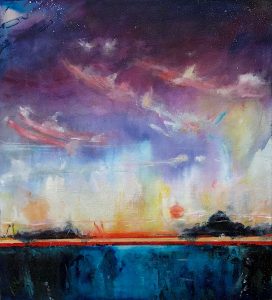
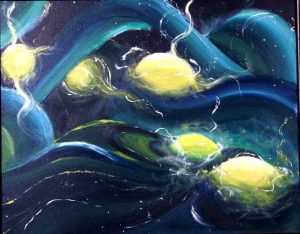
AW—My brother draws. My mom is creative. She did a picture once that my brother took to school and got a good grade on.

DAU—Wow! Did your mom know?

AW—I don’t know. I don’t remember.

DAU—Are you from a large family?

AW—yes, 3 brother and two sisters. I am right in the middle, the oldest girl. 

DAU—and do they support your being an artist?

AW—They are. Although they worry. Very protective of the girls. I wanted to go to Europe to study, and they didn’t want me to. They have not always been on board with the whole artist experience. It wasn’t the art. It was all the other stuff.

DAU—When did you know you were an artist?

AW—I think I always wanted to be an artist. I remember being 6 or 7 years old and watching my brother draw and wanting to do that. Art is always calling me. There are so many distractions. I let things sidetrack me. I don’t recognize the diversions—I get caught up in stuff and then…well, art is always calling me. Some people describe it as a sickness.

DAU—What will it take to let it claim you? Or to claim it?

AW—I can’t answer that. It’s the thing we all struggle with, balancing doing the thing we need to do  and the thing we want to do.

DAU—Is art the thing you need or the thing you want?

AW—oh, both, I guess, at different times. I tried to turn it to something else. I tried graphic design.

DAU—so you went to school for graphic design?

AW—well not at first. I started classes at Sinclair. I had a great teacher there. Curtis Barnes—he really pushed my boundaries. He made me look at the spaces in a painting as well as the color. There was this painting in green and yellow inspired by a book jacket. It made me want to paint. I think it was called Venus Rising. My favorite works are the ones that come from that connection—now that I think about it, I spend a lot of time thinking about that spiritual element. Even when I am not painting.

DAU—and graphic design?

AW—It was just a thing I tried. I always come back to art.  I got a bachelor’s degree in fine arts at Miami. I had good teachers there. Dana Saulnier. Very intuitive artist. Big huge abstracts, but with deeper meaning, very expressive of grief and loss.

DAU—so you went to school in Dayton and then Miami, are you from Dayton?

AW—Dad retired from the air force here in the late 70’s.  I lived in Huber Heights. When I started at school I came into Dayton. It’s not a big town, but it felt so different from Huber Heights. At first, I felt like I didn’t know people,  I missed neighbors and connections.  But you start to know people. You live here, and you get a sense of community. I think Dayton gets a bad rap from the surrounding areas—I think you live outside it, and you drive through it, you don’t see how connected it is. We watch out for each other. We are a community.

DAU—And now you have Wholly Grounds, and you’re a big part of the community.

AW—Thanks for saying that. The coffeehouse was a compromise with my partner—he wanted to open a bar. So, we opened a coffeehouse with a liquor license.

DAU—I think it’s wonderful. Thank you for all you do to support Artists United. Its great to have to gatherings here, and to see the local art on the walls, and you have live music. It’s very welcoming.

AW—And that’s what I want. I want people to come here and feel inspired. I want to be a part of the neighborhood.

DAU—Are you South Park or Oregon?

AW—We’re South Park, on this side of the highway. But I love the Oregon district. There are so many things I like about Dayton. My neighborhood is one of them.  Riverscape. The festivals! I really love the reggae festival. And the Lebanese festival. And the Blues Festival.

DAU—so, all these festivals–is it the music or the food ?

AW—the belly dancers.

DAU—I forgot the belly dancers.


Since our interview, Covid-19 shelter-at-home orders have stopped Artists United from meeting at Wholly Grounds, but they are open for carry-out. Amy and her partner Tony are grateful for the community support they’ve received during this shut down and look forward to having artists back in house. 

Filed Under: Artists United, The Featured Articles Tagged With: Amy Williams, Dayton Artists United, Wholly Grounds

Dayton Artists United: Brian Mathus

April 7, 2020 By Dayton Artist United

Visual artist Brian Mathus gave Artists United a serial interview that started in February and was updated this week.
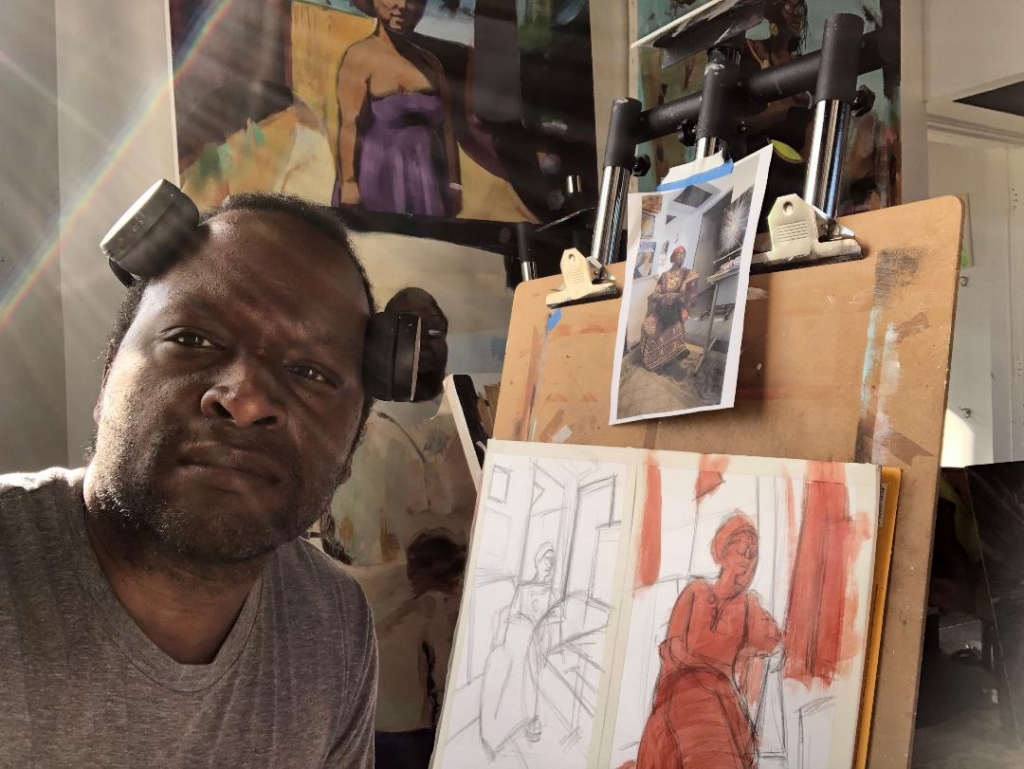
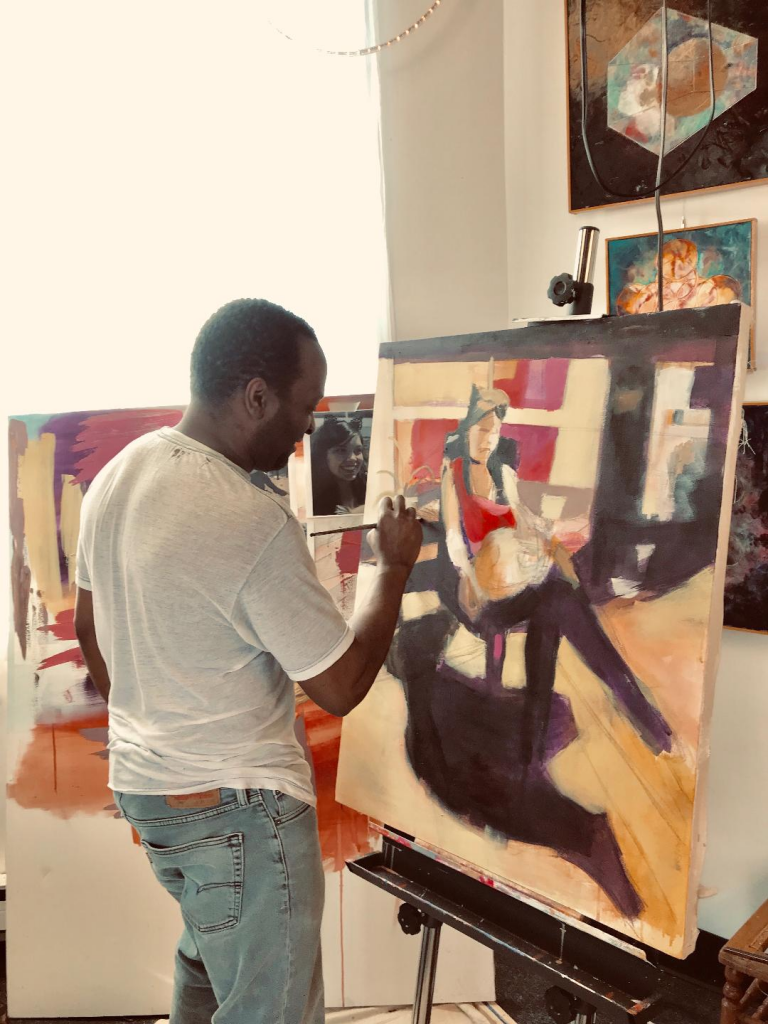
DAU: OK, Brian Mathus, tell me about yourself.

BM—Well, let’s see. Fun fact. I’ve lived on both sides of the country. I lived in Virginia from the time I was 2 until I was 17, then I moved to Portland.

DAU–Portland Oregon?

BM: Yep. And it’s just like you imagine it. It’s where I found my peeps, people like me. It’s so creative there, and everybody is doing their own thing. They have this guy out there that rides a unicycle in a Darth Vader mask.

DAU—I’ve seen the video!

BM-I lived in Portland until I was 30, and then moved to Dayton.


DAU: Where you became an artist?

BM–I think I was always an artist. I just didn’t know how to be one. I made my first work when I was 17. It was a large-scale work called “crabs in a barrel.” I didn’t know how to stretch a canvas, so I just stapled it to the wall. I gessoed it and got gesso all over the floor. When it came time to take it down it was gessoed to the wall. It actually came off with pieces of the wall on the back. 

Years later I worked a frame shop and this woman who worked there help me stretch it into a frame. She complained the whole time about how “this wasn’t how you were supposed to do this.”

DAU—where is it now?

BM—I think it might be at my parents.

DAU—And you’ve been painting ever since? How many works do you think you’ve created?

BM—I don’t know. Over a 1000? I’ve started taking pictures of my work. I’ve sold some, maybe 70 pieces, that I never made a record of.

DAU—So, 70 pieces. Is that a lot? Is it, quit your day job and be an artist full time?

BM—Oh no, no, I’d love to be an artist full time, but I have to have that regular paycheck. I have kids. They’re expensive. I have got to have a day job. I paint houses.

DAU—with murals?

BM—I have made murals. They are expensive, but they aren’t a regular paycheck either. I am a house painter. And a painter. Not at the same time. 

DAU—Have you done any murals in Dayton?

BM—There’s one in Miamisburg, and one in Huber Heights.

DAU—What do you think needs to happen for more artists to make a living from their art?

BM—We have to get rid of the old way of having artwork sell. Very few artists sell paintings priced over 1000. I worked at a gallery in Portland, actually, I helped build a gallery in Portland. All the artists, the small people, got together to make a cooperative gallery. We were trying to sell high end product.  But there was this TV show….. I watched the art market there become saturated and choke out the little guy.

DAU—Well—there’s not a tv show about how odd Dayton is, yet.

BM—True, but the market can become saturated without a tv show. Bill Cunningham has convinced me that producing mid-priced work on a regular basis is a better foundation for a shot at being a working artist. 

DAU—Bill Cunningham at The Orphanage?

BM—Yeah, I just had a show there

DAU: How did it go?  Talk to me about being an artist in Dayton.

BM—The show went well. I sold some work out of it. Being an artists in Dayton has been interesting, it’s a different environment. It is very easy and difficult to be an artist here. It’s very cheap to rent space and have work up. 

DAU: Talk to me more about Dayton. What is your favorite thing to do here?

BM—Take the kids places, the art museum is pretty good and the city is fun for playing Pokémon go.

DAU—Who is your favorite artist and why?

BM—Either Francis Bacon or Rothko, both had the ability to make you feel something that was transcendental, though one represents the sublime and the other represents the letting go of inner angst. 

DAU—What was the last book you read?

BM—Sex before Dawn

DAU—If I were going to make a movie about your life, who would you want to play you?

BM—CalebCity, that dude is hilarious.

DAU—What would the movie be called?

BM—An Ordinary Life, although I’m pretty sure people could find not ordinary things.

DAU—What is the weirdest thing you’ve ever done, seen, painted—take your pick.

BM—Getting shot with a taser and that was a weird sensation.

DAU—If you could have anyone in the world in your studio as a model, who would you like to paint? 

BM–Bjork

DAU: So, what’s next?

BM—More art. I’ve got a series of nudes I’m working on because a woman volunteered. She’s into bondage, I don’t know if that is in my wheelhouse, but it might be interesting. I was working on a series of representation for black people, but models are hard to come by at times. I want to do multiple figures and put some meaning into my work. I have ideas to play with, but nothing solid. But that’s how it always is.

DAU–Since conducting this interview, Ohioans have been ordered to “Shelter at Home, ” I reached out to Brian for an update on how the Covid-19 situation has affected his life.

BM– Well I’ve been laid off so I’m teaching the kids during the day. So far, keeping my hands busy has given me a sense of purpose. I’ve built a lot of canvases. I’ve been able to get some depth in my drawing, because I don’t have to work. I don’t feel the pressure of “I have to get this done today or I’ll never have a chance again.”

I’m not bored at home. But I keep wanting to do landscapes. I’ve tried, it’s too hard.  The people who are outside seem to have no sense of boundaries. I’m guessing a lot of people need more human contact then they are getting.

I do feel this pressure to create meaningfulness, but anything can have meaning if you peel away the veil of routine and look with fresh eyes.


Filed Under: The Featured Articles, Visual Arts Tagged With: Brian Mathus, Dayton Artists United

Dayton Artists United: Cayman K

February 9, 2020 By Dayton Artist United

Artists United Interview with Cayman K, a visual artist.

DAU—So Cayman K, are you from Dayton?

CK—I’ve been here a long time. My family lived in California. I was born in Las Vegas, but lived in California until I was about 7, I guess. We all migrated here, and now some of the family has moved on to Florida.

DAU—too cold here for that California blood?

CK—Maybe! I know I like hot weather.

DAU—and you mostly grew up here?

CK—Yeah, I went to Wayne High School. I went to Sinclair.

DAU–did you study art?

CK—yeah, and general education classes.

DAU—Since you’ve lived in Dayton a long time, tell me some things you like about it.

CK—The restaurants. Lucky’s, Lynn’s Bistro, Thai 9, the Trolley Stop.

DAU—and Wholly Grounds.

CK—and Wholly Grounds! I also like the culture of the city.  Art in the City is a great event. And there’s gallery spaces, like Sideshow  at The Yellow Cab, and The Orphanage. I think Dayton is so receptive to art. It’s a great city. 

DAU—So when did you know you were an artist?

CK—I’ve always been an artist. I have always drawn and created stuff. I have this comic book I drew in pencil, its written in like my third-grade cursive—it’s not in great shape—but it’s about my dog. I made my dog a superhero. Then, I knew I wanted to be an artist.

DAU—And that was it?

CK—It wasn’t that linear. You know how it is, you go to those family dinners where everyone is asking you what you’re doing and how are your classes. You kind of say things, like “It’s good, A’s and B’s,” but what you really mean “I dropped that class because it was too hard.” Your family worries you won’t be able to make a living, so you tell them stuff to make them  less worried.

DAU—And they worried about your being an artist?

CK—Yes, a little. I don’t mean they haven’t been supportive. They have. It’s just that being an artist didn’t seem like a workable job. Once I started selling stuff and making money, they got less worried.

DAU—Cayman K is the name you use for your artwork. How did having a “pen name,” come about.

CK—Cayman K comes from a position of whimsy, having fun for fun’s sake. People nowadays are pretty serious. My art is fun. My art is not political, or controversial—it’s spontaneous. I make it for its own sake. Like most of my work is devoid of background, just a cut-out. I made a character, a cowboy cactus. He’s just random.

I think the world is more divisive. People are willing to write people off. There’s a disconnect. Even if you don’t like each other, do we have to be so hyperbolic?   My art isn’t part of that. It’s playful.

Spike the Gator

DAU—Talk to me more about your art.

CK— I found something that I am really liking doing. I’ve been making art out of salvage wood, inspired by folk art. I have a day job.  I drive for a delivery service.  I drive allover and see a lot of stuff. I see the signs that people put up in their yards, and their garden gnomes. When I go into my studio, I let my mind run over those things, I see them altered. I play with them. I create these characters that exist in one plane. I leave the interpretation of what they mean to other people. It nothing subversive.

DAU—It’s interesting to me that you say your art isn’t subversive, but you call it a “cut out.” In all the spy books, you know,  a cut out is an operative that has no connection to either end of the message. That sounds subversive. And you have a pseudonym you use as an artist, which seems sort of like a spy with an alias. Also, you talk about Cayman K as separate from your everyday self, like an alter ego.

CK—Not a spy. He is different from me, I guess. I started Cayman K as an homage to my grandmother. She always supported me, and she died last year.  I told you how I would tell my relatives stuff at holidays. I told my grandma I was going to be an artist, and I was going to have a studio and do really great work. I was just blowing smoke. I mean, I wanted— I want— that stuff. But I wasn’t doing anything to make it happen. My grandma believed me and believed in me. She always loved anything I did, even when I was just messing around. The name I use, it lets me work. It gives purpose and makes me less serious. It’s cathartic. I am really turning out the work now.

DAU—Do you see the contradiction in being more purposeful and less serious?

CK—Yes, but I am not talking about subject matter. Or maybe I am, but I am not talking about only subject matter. I mean, I was blowing smoke before, and now I am not. I was lazy about working, and I invested working with so much import that I couldn’t work. So, I am working more, I am turning out more work. But I am also less inhibited about how I work. I am not investing every piece with such import that it prevents me from finishing it. I work a lot and I am a lot more productive. There’s a style difference too, you can see it if you follow an idea from work 1 to work 20. 

DAU—and now you have a studio.

CK.—I do. When I started working with salvage wood last year in March, I was just making it work. I had always fooled around with being creative. But the visual arts always appealed to me most. And the wood, it seemed like the right thing for me. So, I started with the salvage wood thing, making it work. I had a folding table and a jigsaw on the patio of my apartment. My early stuff was large, and the works were rough—it’s nearly impossible to make a small piece with a jig saw. But it was so appealing. I took some things to shows, sold some. People liked it; they liked the playfulness of the pieces. I like the playfulness.

DAU—And Cayman K lets you be playful?

CK—Cayman K is playful. He captures an element of my personality, the part of me that I showed my grandmother, maybe. I don’t let Cayman K take on serious stuff. He has a lightness that he needs to keep.  I choose deliberately to avoid cultural controversy in my Cayman K work. I don’t make personal stuff under our name—my personal work is less considered and more intentional. Cayman K exists in a place of imagination, where I don’t take myself seriously. The world is in a shambles, but Cayman K picks up the pieces and makes art. He turns his salvage wood into characters like the giant gator. With Cayman K, I can recapture the state of being I felt when I drew my comic book in 3rd grade.  It’s not sentimental, it doesn’t have any messages—it’s just a purely creative place.

DAU—Is that why you helped create The Little Gallery?

CK—Sort of. I got the idea from a guy in Wisconsin that I follow on Instagram. Dickie, that guy, shared how people were engaging in the art share. I thought it was interesting. I showed it to Bill Cunningham at The Orphanage Gallery. Bill contacted the guy. We had a lot of email exchanges. He sent us some art.  We sent him some art. Bill, and Greg Steiz, in The Orphanage, and I built The Little Gallery. Actually, we built a couple of them. There’s the one outside The Orphanage, and there’s one in The Heights Café in Huber Heights. There’s like eight of them now.

DAU—You put work in The Little Gallery. Bill showed me one, a little purple sculptured head.

CK—I do put work in The Little Gallery, but that one isn’t mine. I took it from the Huber Heights gallery and brought it down. I think the idea of the art exchange is that the art should move around, so lots of people can look at it. It’s one of the things I liked about Artists United when I came to the gathering, the idea of exchanging work.

DAU—That’s one of the things that appealed to me too. It’s why I do what I do for Artists United. Your exchange with Dickie in Wisconsin is like what we did last summer. Artists in Dayton created 3 artworks, and a few artists worked on them. Then they traveled to Pittsburgh, where more people worked on them. They were supposed to go on to Brooklyn, but that event was moved, so it hasn’t happened yet. I’m excited that the collaborative works artists in Dayton and Pittsburgh made last summer will be on display in the group show at The Orphanage. Are you putting a work in the show?

CK—Yeah, I am. I think the show is going to be great. There are a lot of things going up—I think we’re up to almost 50 artists. There is going to be a range of stuff to see. There are so many points of view. You’ll see my work—it’s standout. I’m not saying it standout better, I‘m saying its standout bright. My work is bright. Really bright and quirky. It doesn’t have any message or anything, it’s just loud.

DAU—Another contradiction. Your work is the quiet shouting man.

CK—I guess so. I hadn’t really considered the contradictions before. I’m focused on the color, the fun. I take my inspiration from things I see. I’ve been inspired by anime, in terms of color, I mean. Although,  I’ve done some of that pop-culture thing, you know making work with cartoons and things like that. It’s how I discovered how to talk to people. I would make these pop-culture works and show at festivals—set up a booth. People would come in and talk to me about the work. Cartoons get people to come in. Then, I got comfortable talking to people. It’s the driving force behind selling a lot of pieces, networking—talking to people face to face.

DAU—And you sell online?

CK–  I’ve tried online sales, I still do some, but face to face is the best way I’ve found to sell art. Networking is vital for artists. Twenty five percent of my income comes from my art now, since March. I’ve been able to upgrade the studio. I added a band saw and a belt sander. I can make more work, better work because I have better tools. As an artist, there is so much to manage. You have to make the work, you have to manage yourself, and market yourself. There is no one more self-directed than an artist.

DAU—That isn’t the image most people have of artists.

CK—I know. People think we sit around and dream. We’re inspired to create, and then we create.  You can’t be a working artist and fool around. As a creative person, you have to grow your art. You have to indulge your creativity, but that comes from work, not fooling around.  I still fool around with other things–music a bit, and writing. I like writing, its more ethereal than visual art. But visual art is my creative place. Those other things are fun, and they contribute to my art. I think of things while I am fooling around. But, in my studio, I am working. And not just making art but selling.

DAU—So, Cayman K is an expression of your personality. He is the playfulness of your art, but he is also work.

CK—Yeah. I think he is.

DAU—And what does your family think now?

CK—I think they are relieved I have a direction. I am making money. They can see I’m serious. My fiancé is really supportive. There’s a barrier to people thinking you’re serious when you’re an artist. Having the person closest to you believe you are serious helps you see yourself as an artist.

DAU—And how can people get in touch with you?

CK—They can see my stuff at my Front St studio. I’ll have a piece in the Artists United Show at The Orphanage in March. I’m on Instagram @caymankart and Facebook Cayman K Art.

DAU—Cayman K, thank you for taking the time to talk with me. I think your grandmother would be proud.

Filed Under: Community, The Featured Articles Tagged With: Cayman K, Dayton Artists United

Dayton Artists United: Matthew Birdsall

December 15, 2019 By Dayton Artist United

Photo Credit: Melissa Bautista

Matt is a reader, writer, teacher, lover, and liver, not necessarily in that order. He is eager to read your comments and hopes you enjoy his thoughts, ideas, and positions. Matt believes that life is open to interpretation, and he hopes you take time to disagree with yourself every chance you get!

Matt has been a little corny his whole life. He blames Ohio. In fact, his first word was “combine.” Almost a year old, driving with his mom and dad in an old, green Chevy Chevette, he looked into a cornfield, saw a large machine, and said, “combine.” Neither his mom nor his dad were too pleased that their son recognized farm machinery before he recognized them, but they were pleased with the number of syllables he’d used. Matt still tries to disappoint his parents, but now he uses words like “mother” and “father” to lay it on thick.

Matt is the Managing Editor of the Mock Turtle Zine. Matt has recently published poetry in The Main Street Rag and The Poydras Review. When he’s not writing or spending time with his family, he works in educational publishing, and oversees a tutoring program for homeless children.

Matt recently sat down with Artist United for this interview:

AU–Mock Turtle Zine calls itself  “A literary and arts magazine dedicated to supporting Miami Valley creatives,” tell me about it. 


MB–We’ve been around for just over ten years. Each year we produce 2 issues. We’re coming up on Issue 21. Mock Turtle Zine was founded by Christina Dendy. Initially, I was published in the first two issues, and then I started helping with the publication. The current team and I took over the zine about 2 years ago. As always, we are an all volunteer staff. The Zine is free to everyone. All submissions are read blindly and judged on their merits. We accept submissions from all over, but the Miami Valley gets first dibs. 


AU–Tell me about the name Mock Turtle.


MB–The Mock Turtle is a sub-character in Alice in Wonderland. It originally came up in a conversation between Christina and Ron Rollins. I think Ron takes about 80% credit for coming up with the name. I like the name, but we are considering a change, just considering it for now, because we would like it to reflect Dayton.

Stay tuned…


AU–You said that Mock Turtle was your labor of love, do you want to talk about your day job?


MB–No, thanks. I talk about my day job way too much. Let’s just say that I work in educational publishing and technology. I love it. Let’s leave it at that. 


AU–OK then, let’s go back to the Zine. You said that submissions are open, and the works are blindly judged, but what are you looking for? 


MB–It depends, really. We value craftsmanship and originality. But, c’mon–who doesn’t? When I dive into a piece, I want to be shocked by the frigid water in the deep end of the artists’ creative swimming pool. After I surface and catch my breath, the piece should allow me to float, but there needs to be a current pulling continually tugging at me from below. With all that said, folks need to  know that there are times when a work that is really strong just doesn’t fit how the Zine is coming together. Maybe the work is too long for how much space we have. Heck, sometimes the flow just appears organically within the submission pile that overrides the merit of any one work. 


AU–Do you provide feedback on works not published?


MB–Sometimes. If someone asks for it. I think feedback is a double-edged sword. It forces you to provide a rationale for what you’re doing, and that doesn’t necessarily help. I think the thing I most want to say to people who get told “no” is that “no” doesn’t mean “stop”. Don’t get discouraged. There are so many reasons the answer might be “no”. I implore everyone to read “no” as “try again.”


AU–Good to know. Besides open submissions how do you reach out to authors and artists?


Pauletta Hansel

MB–We actively participate and engage with our community. Mock Turtle is all about community. We love to attend local events. For instance, this week was the Winter Solstice Poetry Reading.  Every year, friends of the Tecumseh Land Trust and Glen Helen gather for an evening of poetry in honor of the Winter Solstice. The lineup this year included the first poet laureate of Cincinnati, Pauletta Hansel, a Dayton Literary Peace Prize nominee, Moriel Rothman-Zecher, the president of Ohio Poetry Association, Chuck Salmons, and the mother-daughter team Karen and Alexandra Scott. 


We are also proud to have judged the annual Dayton Metro Library Poetry Contest in the past.  The contest is held (almost) every year in April in honor of National Poetry month. Winners are published in the Zine. It’s one way we reach out to new authors. We hope that those authors will come back to us–sometimes they do. We have rotating readers for each issue–all volunteers.


For the past few years, there have been fewer and fewer visual art submissions. However, we keep up with the Miami Valley Art scene. For the last three issues, we have personally reached out to prominent artists in the community for cover submissions. Hopefully, working with Artists United will bring in more art submissions. We want to publish creative works of all mediums.


AU–And the Zine is free? How are you funded? 


MB–Our funding comes from donations, sponsorships, and advertisements. Recently, we’ve supercharged our advertising online–we like cross pollinating–so our vendors get lots of social media exposure. We’ve also revamped our website to facilitate deeper community engagement. The new site makes it easy to donate or offer sponsorship.   


AU– How long does it take to produce the Zine? 


MB–Mock Turtle Zine publishes twice a year, spring and fall. Submissions come in all the time, so we have lots of material.  The spring issue hangs a bit on the Dayton Metro Library’s poetry contest, but with our great staff of readers and the attention to detail and layout skills of our Artistic Director, Melissa Bautista, it all comes together in four to six weeks. I am excited to see what the next issue holds…

Filed Under: Community, The Featured Articles Tagged With: Dayton Artists United, Matthew Birdsall, Mock Turtle Zine

Dayton Artists United: Doug Fiely

November 24, 2019 By Dayton Artist United

In 1964, Doug Fiely  was given a guitar which opened the door to both the visual and performing arts. That guitar served him well as he spent many weekends/evenings playing rock ‘n roll in Ohio, Indiana, and Michigan. For over 40 years, he raised chickens, goats, turkeys, and children while teaching at Stryker Local Schools. Upon retirement, he was asked to teach Printmaking, Painting, Drawing, Art History, Figure Drawing, Color and Design, Global Civilization and even the “History of Rock ‘n Roll”, retiring in 2013 as Professor Emeritus from Defiance College.

Dayton Artists United had the privilege of visiting with visual artist Doug Fiely in his new studio space in South Park Historic District.

DAU–Am I right in thinking you are not from the Dayton?


DF-That’s right. I grew up in Celina, OH, along the lake. The lake was my early inspiration.


DAU–Tell me about the first thing you remember creating. 


DF–It was a picture of the Beatles George Harrison. In 1963, when the Beatles came out, I was interested in depicting things. I was a kid that always looked at things closely, you know. I would count the rings on a turtle’s back, examine bird tracks, and when I caught and cleaned a fish, I always paid attention to their scales.


DAU–So, you always knew you wanted to be an artist?


DF–Oh no. I just drew a lot. I didn’t really know what I wanted to do. I applied to college in art because a neighbor in Celina said my drawings were good.  I got in to Bowling Green on probation–I had a bad class rank. There was a lot of competition for college then too because of people wanting to avoid the draft.  So, because of the probation, I went to summer school there as an art major. It was hard. I had no arts education in high school, and all the other students knew stuff about art and art history that I didn’t. I was insecure about that—I liked all my other classes more than art.


My family ran a daily newspaper in St. Mary’s OH. I went there a lot as a kid and watched the print machines. In the fall, I got into a printmaking class at Bowling Green. I walked into that class feeling dejected about how behind I was in my arts knowledge. I smelled the ink. I saw the plates. Something just clicked, it was familiar, you know. I did my first etching. I rubbed the ink into a woodcut of an owl. I entered my print work in a student show, juried by the professors, and won second place. Printmaking became the focus of my attention, it was my comfort zone.

DAU-So, when did you start to paint?


DF–I thought the painters in my classes were brilliant. Especially the women painters. They could really see color. I struggled. The one of my professors, Bob Mazur, told me to treat my canvas as a print block.


DAU-What did that meant to you?


DF–Well you engrave a print block. I treat my painting like engraving. I build up modeling paste on heavy canvas and scratch into it, then I stain it with paint. It’s a more spontaneous way of working for me. I think in lines, like a printmaker. I wish I were more bold with color, that I could channel emotion into the paint the way my daughter Megan does. The scratch and stain method opens doors for me. I can see the lines in everything I am doing, fat fish, skinny fish, blackbirds, vegetables. I shape the lines and then let the color in.


DAU-You think your art is not emotional? I see it as very personal.


DF–My art will show a personal reaction to a subject. Like my blackbird series. I was painting these birds. I’ve got several blackbird canvases, but in this one the birds are dead. I was painting that at the time Tom Petty died, and there was that shooting in Las Vegas. I was painting these birds, and at that time I saw a dead blackbird in the yard. The details were just there. The same way you notice the details of George Harrison’s beard or Bob Dylan’s eyes, I noticed the details of that dead bird, it’s stiffness, the rigid claws. I was upset by the drug overdose and the shooting, and these dead bird details came through in the work. You can see how sensitive the lines of the work are–here (points).

Doug in his studio. Photograph by Bill Franz

DAU-You have mentioned famous rock musicians several times this morning. Do you think their music has influenced your art. 


DF–They influenced me. All the musicians I like went to art school. Pete Townsend, John Lennon, Ray Davies of the Kinks, Bob Dylan–some people say his paintings are better than his songs–John Mellencamp, Joni Mitchell–she’s releasing a book of art with song lyrics–Patti Smith–who was with Robert Mapplethorpe. Artists and musicians. Because of them I took up the guitar. 


DAU- Do you still play?


DF–I do, I even thought I might get some gigs, but when I looked around the music scene in Dayton, I thought, “I am not good enough.” You know, Dayton is powerhouse of diversity in the arts. In the visual arts you’ll see everything from urban non-objective to hyper-realism. There are so many strong arts organizations: The Dayton Society of Artists, The Contemporary Dayton, Front Street, the Dutoit Gallery, The printmakers Co-op. And the music is just as supported. There is really good music here. The musicians are way better than me. 


DAU-That’s what you thought about yourself in art school too!

DF–Yeah, well, at the beginning. I got four B’s that first summer semester at BG. But after that first printmaking class, I found my way. I’ve continued to move forward. I’ve continued to win awards. I am confident about my art now. A lot of people look at my work and think Fiely is traditional, Fiely is folksy. I look at my paintings and see composition and line, balanced. My work is hanging in people’s homes and in galleries. I am doing what I always wanted to do. But, it’s a struggle. It’s work. It drains energy, like cutting down a tree, it’s physical.  Art is a long haul. I don’t think I have gotten to the point where I’m done. 

Filed Under: The Featured Articles, Visual Arts Tagged With: Dayton Artists United, Doug Fiely

Primary Sidebar

Submit An Event to Dayton937

Join the Dayton937 Newsletter!

Trust us with your email address and we'll send you our most important updates!
Email:  
For Email Marketing you can trust
Back to Top

Copyright © 2025 Dayton Most Metro · Terms & Conditions · Log in