• Skip to primary navigation
  • Skip to secondary navigation
  • Skip to main content
  • Skip to primary sidebar
  • Home
  • Event Calendar
    • Submit An Event
  • About Us
    • Our Contributors
    • Subscribe
  • Advertise
  • Contact Us
  • Where to Pick up Dayton937
  • Arts & Entertainment
    • Art Exhibits
    • Comedy
    • On Screen Dayton
    • On Screen Dayton Reviews
    • Road Trippin’
      • Cincinnati
      • Columbus
      • Indianapolis
    • Spectator Sports
    • Street-Level Art
    • Visual Arts
  • Dayton Dining
    • Happy Hours Around Town
    • Local Restaurants Open On Monday
    • Patio Dining in the Miami Valley
    • 937’s Boozy Brunch Guide
    • Dog Friendly Patio’s in the Miami Valley
    • Restaurants with Private Dining Rooms
    • Dayton Food Trucks
    • Quest
    • Ten Questions
  • Dayton Music
    • Music Calendar
  • Active Living
    • Canoeing/Kayaking
    • Cycling
    • Hiking/Backpacking
    • Runners

Dayton937

Things to do in Dayton | Restaurants, Theatre, Music and More

  • Facebook
  • Twitter
  • YouTube
  • Instagram
  • Pinterest

peruvian cusine

Peruvian Street Food Makes Up the Menu at Fino Sur

May 28, 2020 By Lisa Grigsby

The husband and wife team behind FINO SUR were both born in Lima Peru.  They came to Dayton 15 years ago and have been working in restaurants over the years, while catering Peruvian food for friends and parties.  Last September they participated in The Heritage Festival and after success there, decided to open a restaurant  featuring the foods they loved to make.

The goal was to open the new restaurant in Centerville, OH early March 2020 and bring delicious Peruvian dishes and culture to the city. Unfortunately, the covid-19 crisis delayed our opening but they are finally ready to serve you.
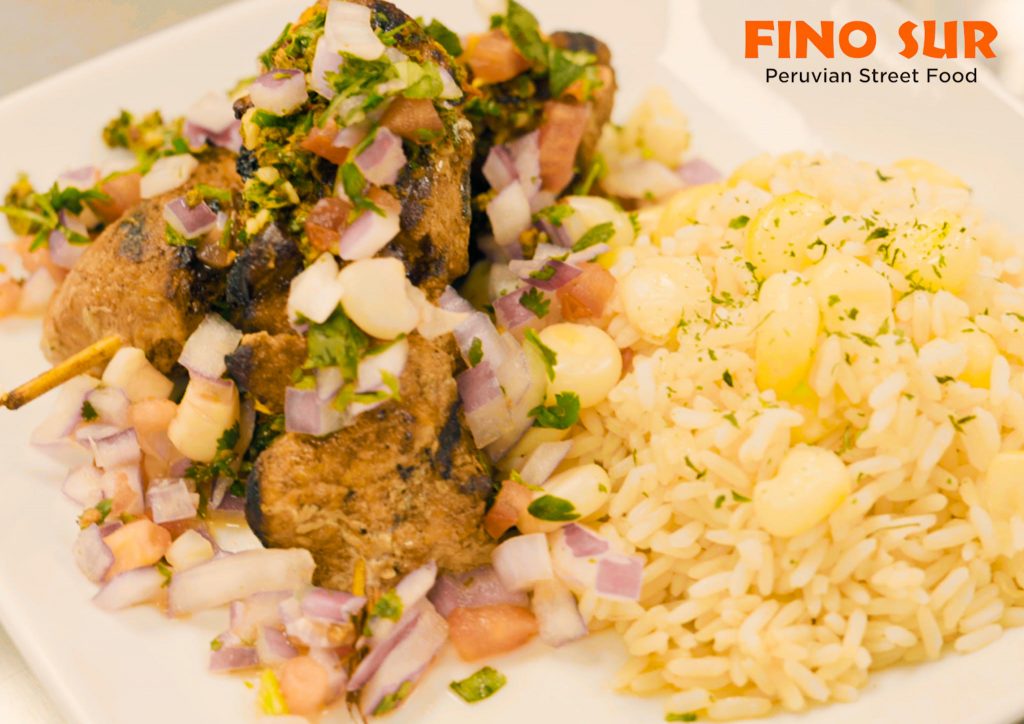
 

Learn more about the food they serve:

How would you describe Peruvian cuisine?
Peruvian cuisine as we know it today is a product of miscegenation that occurs in Peru. First The arrival of the Europeans with the discovery of America and the conquest. Then they come to migration from different parts of the world. This is how Africans, Chinese, Italians, Japanese, Jews, and Arabs arrive. This mixture of cultures and races was given in the homes of Peru. Immigrants begin to cook the products they find in the new continent using their techniques. This is the case, for example, that the Lomo saltado is born, pieces of meat sauteed with onion, tomato, yellow pepper, tools such as the wok and the technique of the Chinese immigrants that giving it a few turns and the wrapping in the flames creates an exquisite dish like this.What does anticuchos mean? 
The name of anticuchos derives from the Quechua words “Anti”: an eastern region of the Andes and Kuchu: cut. They are popular and inexpensive meat dishes that originated in the Andes during the pre-Columbian era specifically in the Antisuyu region of the Tahuantinsuyo (Inca Empire). The most popular anticucho is that of the heart of beef and you find it in the streets of Lima as well as in restaurants.
Why is one of the most popular sauces of Peruvian food called Huancaina sauce? 

The most popular sauce of Peruvian cuisine takes its name in tribute to the city of Huancayo in the Mantaro river valley in the Junin region. The creator of the recipe bought the potato in this region and named it in honor of the city of Huancayo “Papa a la Huancayo-Huancaina”.


What is Rocoto?

Rocoto is a hot pepper. Its name has its origins in Quechua “luqutu” o “rukutu” is found mainly in Peru and Bolivia. Rocoto is a hot pepper that dates back to pre-Inca times. For those that like spicy food we are making a spice sauce to accompany your food.

What is Chimichurri sauce?

A sauce that has origin in South America in the countryside of Argentina and Uruguay. It is made of finely chopped parsley, minced garlic, oregano, olive oil, and red wine vinegar. Exist different recipes that add other ingredients to those already mentioned. Chimichurri is used as a condiment for grilled meat.

What is Golf Sauce?

It is a South American cold sauce a base of tomato sauce, mayonnaise and other ingredients. According to the legend, it was invented by Nobel laureate Luis Federico Leloir in the mids 1920s at a golf club at the seaside resort Mar del Plata.

What is Chalaca sauce? 

It is a sauce that accompanies one of the most popular dishes of Chalaco origin, called “Choros a la Chalaca” (the native people of the region of the port of Callao are called Chalacos). This dish consists of cooked Choros (a mollusk from the mussels family) accompanied by this sauce consisting of diced onion, squared tomatoes, boiled corn kernels, coriander, and lime juice.

What is Criolla sauce? 

Criolla sauce It is the sauce consisting of red onion in julienne cut, chopped yellow pepper, chopped cilantro, and lime juice, which is a classic accompaniment in different dishes of Peruvian cuisine.

Why are there products that Peruvian cuisine uses that we don’t know? 

When Europeans arrive in America a kind of natural exchange begins, they carry a basket of products that spread them in Europe and the world for example: the potato that was a native product of Peru and was universalized now you find a variety of potato in any part of the world. There are many Peruvian products that were left to say in some way hidden in the Peruvian mountains and were not used for many centuries since the Spaniards replaced some products of the Andean diet with cereals until recent times that we have begun to explore and spread its benefits, an example of one of these products is Quinoa.

How many varieties of potatoes exist in Peru? 

In Peru, there are more than 5,000 varieties of potatoes. Peru is considered Globally as the first country in potato biodiversity. Only in the region of Cuzco, there are more than 1,500 varieties of potatoes and it is within Peru the region with the greatest diversity of native potatoes.

Is Peruvian food spicy? 

Peruvian food uses a variety of species and ajies native to the region to season the food. Some dishes are spicy and others are not. That depends on the taste of each person but I think in general we make dishes with a moderate level of spicy.

How many varieties of chili pepper exist in Peru? 

In Peru, there are more than 350 varieties of ajies and many more varieties to explore in some regions of Peru. Among the best known and used varieties are yellow pepper, rocoto, aji panca, aji limo, aji mirasol is a sun-dried pepper, aji mochero, etc.

What type of side dishes accompanies Peruvian food? 

The dishes of Peruvian food are served with potatoes, cassava, corn, rice, sweet potatoes, fried plantains, and pasta. These fittings vary according to the different regions.

What has been the phenomenon that has turned Peruvian cuisine into one of the most prestigious kitchens in the World? 

For more or less 25 years, a movement originated by a group of Peruvian chefs began, some who returned from Europe and other parts of the world and others who studied in Peru leaders who left their pride and vanities aside and began to talk about how to rescue old recipes, improve those that had and joined together to develop new ideas and different projects. Thus, in 2008, the MISTURA International Gastronomic Fair of Lima opened for the first time not only for cooking but for culture, tradition, and diversity. In addition, the Pachacutec cooking school is created in Ventanilla, subsidized by the arzobispado del Callao, for low-income people and with foreign donations, such as a library brought from Spain and the help of renowned Peruvian chefs. This school was created to give opportunities to low-income children and use gastronomy as a social weapon and transform lives and create opportunities for young entrepreneurs. It is so that today there are thousands of restaurants not only in Peru but also in the most important cities in the world, all this has turned Peru as a tourist destination and culinary destination.


Fino Sur

937-813-8716

Crosse Pointe Center
101 East Alex Bell Road, Suite 186
Centerville OH 45459

Monday – Saturday
11:00 am – 8:00 pm

Sunday
11:30 am – 8:00 pm

Filed Under: Dayton Dining, The Featured Articles Tagged With: Fabrizzio, Fino Sur, peruvian cusine

Next Ethnosh Experience Explores Peruvian Cuisine

January 30, 2020 By Talia Bartoe

Chef Margot. Photo by Bobby Tewksbury

Originally a fashion designer hailing from the capital city of Lima, Peru, Margot Blondet has always been passionate about creating beauty. After spending some time in France, she decided to leave fashion behind and return home.

When her best friend opened a culinary school with Le Cordon Bleu, Margot saw it as a golden opportunity to pursue something she enjoyed while spending time with a beloved friend. After studying and working for nearly two years, word got around of her delicious food. People started asking Margot to come to their house to cook, all while she continued to take classes at the culinary institute. Becoming a chef wasn’t her first path, but it became clear this was a world in which she could weave together her love for cooking and making beautiful things.

“It’s a lot of thinking. Every dish needs to be pretty, not just good,” states Margot Blondet, Executive Chef and Owner. She spends the next hour describing to me all that truly goes into designing the perfect experience when dining at Salar. “It’s a theater” she states. No detail is too small.

“Coming to a restaurant is not only about the food, I think it’s about the space, where you’re sitting. It’s about the plates you are being served on. It’s about the lights, music, the service, the smell.” Salar Restaurant and Lounge is located in the ever-popular Oregon District in Dayton. The area is filled with many eateries but one glance inside Salar and you won’t be able to deny the unique elegance and charm.

In 2005 Margot elected to relocate herself and her children to Florida for a much-needed change. She had only planned on staying just a few months, but life had a surprise in store for her. She reconnected with her high school sweetheart, and they picked up their relationship and fell back in love. When he was offered a job in Ohio they moved together and got married.

Margot did some catering for some time when she met the owner of Sidebar. She was asked to help open the restaurant here in Dayton and one in Columbus for him. Although that establishment closed, the owner of the building was so impressed with her work, he offered the space to her if she was interested in opening a restaurant of her own, and that is how Salar was born.

Photo by Bobby Tewksbury

Salar, which means to salt, or season, was opened in 2013. “I love salt. Salt is the essence of life.” Margot points out the many pictures of salt around the restaurant. Most of the pictures were of the salt mines in Peru, which Margot has visited herself. The salt mines are still active, as they have been since the time of the Incans. Chef Blondet has many varieties of salt in her kitchen, all with a distinctive flavor of their own.

When asked what she loves most about cooking she tells me that she is not the most patient person. Delayed gratification is a difficult thing, but with cooking, you get rewarded straight away. She goes on to say, “You feed somebody, and they try it and they like it. You see their face and its immediate.” Feeding someone a good meal is satisfying, “The restaurant came after the food by logic.”

The food at Salar isn’t strictly traditional Peruvian cuisine if there ever was such a thing. Margot describes Peru as “the catalog of the world.” Everything from their culture to their dining has been influenced by immigrants from all over the world. “We have a lot of Chinese immigrants. A lot of Italian immigrants… We were conquered by the Spanish too.” They also have influences from Africa, and the Middle East. In addition to all the cultural influences, Peru is known for its over 90 microclimates. Microclimates are pockets of weather conditions that differ from atmospheric conditions nearby. These variations mean the food available locally is entirely dependent on what part of Peru you reside in. “I haven’t even eaten all the food”, Margot chuckles.

The food at Salar Restaurant and Lounge is all house-made. “If you want French fries, you have to peel the potatoes.” Margot is dedicated to sourcing the best ingredients in the market, as flavor and quality are priorities for her. Even the cocktails are made completely from scratch. “I put a lot of love. This is like my second house”.

Owning a restaurant has not come without adversity. In 2017 Margot was awoken with a phone call letting her know her restaurant had caught fire. “I thought it was a prank at first.” Sadly, this was no joke. This was a very painful process for her, especially because she felt responsible for her employees. It took 9 long months to get the restaurant open again. As difficult as that was for her, Margot’s mindset looking back at the whole experience is impressive. “It was an opportunity, as much as it was a bad thing, in the end, once you pass it, you see it as a good thing because everything is brand new. You build something better.”

Photo by Bobby Tewksbury


Through the course of the remodel, Margot gave special attention to every aspect from the Peruvian art adorning the walls to the stunning chandelier hanging in the Pisco bar that Margot put together with her own hands. Pointing to an alluring waterfall feature, she informs me that it’s not just for aesthetics, but also doubles as an air purifier. Everything in the entire space has been chosen with much thought, all intended to cultivate an atmosphere and give the diner much more than a delicious meal. “That’s the whole mentality here that we try to do. From him (pointing to the gentleman greeting the customers at the door) with a big smile to welcome you.”

Margot gives me a tour of the restaurant, and somehow each room is more lovely than the last, ending at the intimate outdoor patio space. I marvel at how she has pieced together each component of the experience together like a puzzle. “The food is just one piece of it. The food is a start. It wouldn’t be possible without all the other elements.”


SALAR RESTAURANT AND LOUNGE

Photo by Bobby Tewksbury

400 East 5th Street
Dayton, OH 45402
(937) 203-3999

NoshUp at Salar  Sun, Feb 23

Get a plate full of some great Peruvian cuisine and meet Salar Chef-Owner Margot Blondet, who will share her story of Lima to Dayton and fashion to food.

SEATINGS & INFO

There are 3 seatings for this event:

Seating 1: 2:00 PM – 3:30 PM
60 ticket capacity
Seating 2: 4:00 PM – 5:30 PM
60 ticket capacity
Seating 3: 6:00 PM – 7:30 PM
60 ticket capacity

Buy your tickets online here. 

Vegan and Vegetarian plates are available. Please be sure to select your preferred option on your ticket order form.

For those interested in adding an adult beverage, Salar will have beer, wine and select Peruvian-influenced cocktails available from their bar.

Filed Under: Dayton Dining, The Featured Articles Tagged With: Chef Margot, ethnosh, peruvian cusine, Salar

Primary Sidebar

Submit An Event to Dayton937

Join the Dayton937 Newsletter!

Trust us with your email address and we'll send you our most important updates!
Email:  
For Email Marketing you can trust
Back to Top

Copyright © 2025 Dayton Most Metro · Terms & Conditions · Log in