• Skip to primary navigation
  • Skip to secondary navigation
  • Skip to main content
  • Skip to primary sidebar
  • Home
  • Event Calendar
    • Submit An Event
  • About Us
    • Our Contributors
    • Subscribe
  • Advertise
  • Contact Us
  • Where to Pick up Dayton937
  • Arts & Entertainment
    • Art Exhibits
    • Comedy
    • On Screen Dayton
    • On Screen Dayton Reviews
    • Road Trippin’
      • Cincinnati
      • Columbus
      • Indianapolis
    • Spectator Sports
    • Street-Level Art
    • Visual Arts
  • Dayton Dining
    • Happy Hours Around Town
    • Local Restaurants Open On Monday
    • Patio Dining in the Miami Valley
    • 937’s Boozy Brunch Guide
    • Dog Friendly Patio’s in the Miami Valley
    • Restaurants with Private Dining Rooms
    • Dayton Food Trucks
    • Quest
    • Ten Questions
  • Dayton Music
    • Music Calendar
  • Active Living
    • Canoeing/Kayaking
    • Cycling
    • Hiking/Backpacking
    • Runners

Dayton937

Things to do in Dayton | Restaurants, Theatre, Music and More

  • Facebook
  • Twitter
  • YouTube
  • Instagram
  • Pinterest

stone brewing

Stone Enjoy By 11/09/12 IPA – The Countdown to Irrelevancy

October 11, 2012 By Max Spang Leave a Comment

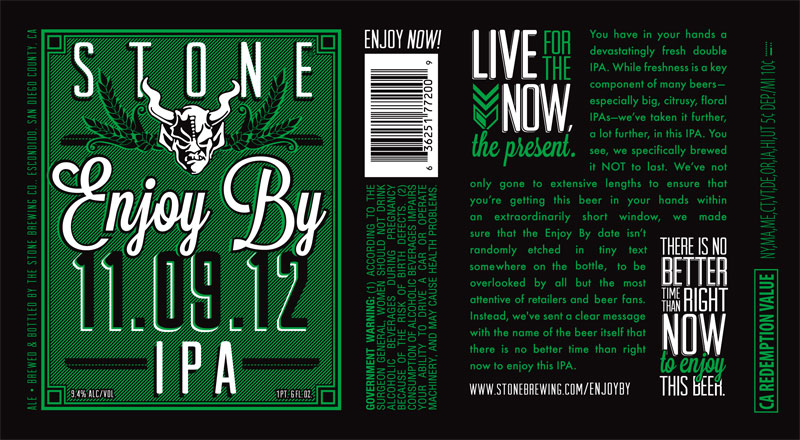
Stone Enjoy By 11.09.12 IPA
This beer has gotta be enjoyed fresh! I know because the bottle told me so. So fresh, in fact, that this very review is going to be irrelevant in a matter of weeks. Not only does the freshness factor come into play, but the fact that this beer has a very limited distribution (this batch only made it to Ohio and Colorado in small numbers) makes this review nearly pointless. However, as the ever-vigilant beer drinker that I am, I figure why the heck not? I mean come on, this beer was only bottled six days ago! You can’t get much fresher than that unless you feel like swimming around in fermenters… which really doesn’t sound like that bad of an idea now that I mention it…

Anyhow, this beer is 9.4% alcohol by volume and was designed to be consumed FRESH. Like, ridiculously fresh (did I mention it was only bottled six days ago?). They threw a bunch of hops in late into the boil (a technique called “hop bursting”) which contributes more hop flavor and aroma rather than bitterness. Check out more information about this beer here. To you Daytonians, this beer has pretty much sold out at most stores already (and thus more irrelevancy), but if you see it on the shelf at your favorite bottle shop then by all means pick it up. Let’s get to reviewin’.

APPEARANCE

This is what those in the advertising business call “Sex Appeal”. This beer just looks good. Crystal clear, yellow-orange-amber in color, resting under a slightly off-white head… Yeah, this is the kind of beer that makes mouths water. I love the look of a good IPA, and this beer has got that look. If this beer was a female, I would try my best to “holla”. If this beer was a painting in an art gallery, I would stare at it intensely and occasionally nod my head so everyone around me knew how much I knew about art or whatever. If this beer was a Big Mac, it would be the one in the picture and not the one you get when you order it. If this beer was a… Ok, you get my point.

SMELL

There are definitely some New Zealand hops in the nose. Notes of grapes, flowers, mango, citrus, earthiness, and a smidge of everyone’s favorite “cat pee” fill my nostrils. There is a deep, dank smell that reminds me of a quaint but “lived-in” basement which adds a bit of charm without being unpleasant. There’s even a bit of hop spice aroma to even things out. There is a good amount of sweet malt, but there’s no mistaking that this beer is all about the hops.Stone Enjoy By 11.09.12
TASTE

Follows the nose very closely. Once again, the first thing I notice is the deep, dank, resiny hop character. There is a bit more pine on the tongue than on the nose, which at first I feared would be the dominating character. As I sip, however, more of the citrus and tropical fruit comes out. The New Zealand hops make another appearance and bring some earthy grape notes with them. As far as bitterness goes, this beer is on the medium side. Sure, it’s bitter, but it’s not a tongue splitter (I rhymed!). There is almost no alcohol flavor whatsoever. This beer has a ridiculous amount of hop character, and there is a slight muddling of flavors which is a tad disappointing. Overall, this beer is pretty tasty but nothing I’ll be craving.

MOUTHFEEL

The mouthfeel really is one of the highlights of this beer. The carbonation and body are both medium, and considering the ABV this beer is not a struggle to drink. The beer coats the mouth with hop resin – the kind that kind of makes you smack your tongue for no explicable reason.

OVERALL

You may have noticed that a word I didn’t use in this review was “bright”. Many IPAs have a bright, refreshing crispness that fellas like me go nuts over. This beer, however, has a somewhat muddled flavor that makes me feel like it’s more of an English IPA than an American IPA, which is crazy talk considering all the American hop flavors. That’s not to say this beer is bad, because it’s not at all! It’s really an excellently balanced IPA, and it drinks more like 6% than 9.4% ABV. That being said, I’m drinking this beer as fresh as possible and it still has a layer of “meh”. Is it worth buying? Yes, absolutely! Is it the IPA to end all IPAs? Not this time. Don’t feel too bad if you missed out on this one (or if you drank it on 11.10.12 or something).

Cheers!

SCORE: ★★★ 3/5

Filed Under: Dayton On Tap Tagged With: 11.09.12, Beer, beer reviews, Craft Beer, enjoy by, enjoy by ipa, india pale ale, ipa, max spang, ohio, snobby beer, stone, stone brewing

Aging Beer Like Fine Wine

December 13, 2011 By Max Spang 3 Comments

Beer Cellar

Have you ever had a Bud or a Miller that was just a little bit too old? Perhaps someone left it in the garage during a party in the Spring, and you forgot all about it until well after Summer was over. You thought “Oh, what the heck” and cracked it open to see how it tastes.

Uh oh.

If you’ve done something like this, then you are probably scarred for life. The thought of aging beer may sound like a one-way ticket to Skunksville. However, you may be surprised to know beers, like wine, can actually mature for months, years, and even decades. You might even find the occasional bottle that has a “Best After” date rather than a “Best Before” date. The idea of sitting on perfectly good beer for months or years may sound crazy to you at first, but your patience will be rewarded in the long run.

Here are some things to think about regarding aging beers.

The Environment

The most important factor in aging your beer, also called “cellaring”, is the environment in which it will be aged. Throwing it in the garage or attic might be slightly more convenient in terms of space, but that kind of unstable environment is no good for storing beer.

Beer Cellar

Caves make great environments for beer. You know, for those of you who have an extra cave laying around

The optimum environment for beer is a cool and dark area with minimal temperature fluctuations. Light and high temperatures will do terrible things to beer over time. The optimum temperature range for most beer aging is 50-55 degrees Fahrenheit (10-13 degrees Celsius). You want the bottles to remain relatively dry but have enough moisture in the air to prevent corked beers from drying out. You also want to store your beer upright as opposed to horizontally like wine, even with corked beer. More information on why you store beer upright can be found here.

Unless you have a cave system underneath your house, this environment isn’t necessarily readily available in most homes and apartments. Fortunately, there are other options available. A wine chiller with the racks taken out can make a great spot to age beer. An extra refrigerator with a thermostat may also suffice, but keep in mind that refrigerators are very dry and may cause corked beers to dry out over time. If you have a basement, underneath your stairs or in a in a dark corner may be adequate places to age your beers. If you don’t have a basement, a small closet may be a suitable option. However, the general consensus is that if you are not in optimum cellaring conditions, you should only age beers for 2-3 years max.

Organization

Organization may not be a big concern when you first start aging beers, but after having a large random collection of unidentifiable bottles laying around you’ll learn the importance of organization. How to you go about organizing beer? That is entirely up to you. You may want to organize by brewery, style, age, or other ways.

Beer Cellar

Make sure your beers are easily-identifiable.

No matter which way you organize, you want to be able to easily identify what the beer is, who makes it, and how old it is.

If you have the space and can afford it, shelving units are some of the best and easiest ways to organize your beer. Just set up a few shelves, and stack the beers with the labels face-out.

You may also want to put dates on the beers that don’t have the “Bottled On” date printed on the label. I personally write the dates on strips of paper, then stick them on the neck of the bottles with clear Scotch tape. Dating bottles is important because it’s easy to lose track of the age of beers as your collection grows.

The Beer

Now that you know a little bit about storage, you can start thinking about the important stuff; the beer. There are a lot of types of beer that are great candidates for aging, and many that are not recommended to be aged. There are a few general rules of thumb regarding what types of beers should be aged:

High Alcohol Beers

Alcohol is one heck of a preservative. High alcohol beers are usually prime candidates for aging because they will remain preserved while the flavors mature over time. Generally speaking, beers over 8-9% Alcohol By Volume (ABV) can be aged for up to a few years. Beers that are much higher, closer to 15% and up, can be aged for many, many years. Not all high ABV beers are good candidates for cellaring, but this is generally a good starting point.

Bottle Conditioned/Refermented Beers

Sometimes, brewers will leave a small amount of yeast when they bottle their brews, which carbonate the beers naturally. These beers are known as “Bottle Conditioned” or “Bottle Refermented” beers. You can tell if a beer is bottle conditioned by holding it up to light and seeing the little slurry of yeast at the bottom of the bottle. Don’t be alarmed if you see this, yeast are perfectly fine to drink – though, you may want to leave the last ounce or so in the bottle as you pour so you do not affect the flavor of your beer. Bottle conditioned beers have live yeast in them, which would love nothing more than you hang out and create subtle flavor changes to your beer over time. Not all bottle conditioned beers can be aged, but it is something to look for on your beer aging quest.

Lambics/Sours

Lambics, and some other sour beers, contain a cocktail of natural yeasts and bacteria. Lambics go through what is called open fermentation or spontaneous fermentation, meaning only natural yeasts and bacteria from the surrounding area are used to ferment the beer. Lambics are considered one of the best beers to age, and many Lambic enthusiasts may argue that they will only get better with time. Generally low in alcohol, these sour beers rely on the living organisms that are contained in the bottle to keep them preserved. Their aging potential is extraordinary – I have read about lambics being aged for over 40 years and still tasting amazing! Other sour beers, such as American Wild Ales, contain many of the same bacteria and natural yeast as Lambics, and will continue to mature as the years go by.

Recommendations of Beers to Age

Not sure where to start? Here’s a few recommendations of beers to grab and age.

Sierra Nevada Bigfoot

Sierra Nevada Bigfoot. Buy a sixer - drink some now, some later.

Sierra Nevada Bigfoot
An American Barley Wine, Sierra Nevada’s Bigfoot is released once a year in January. The bottle has the year printed right on the cap, which is handy for organization. They sell this beer in six-packs, which gives you the opportunity to easy get a collection started. The beer is very hop-forward when it is fresh, and will mellow out and become much smoother over the years. This is perhaps one of the easiest beers to grab to start your cellar.

Stone Vertical Epic Beers
These beers from Stone are all designed to be aged and enjoyed “Sometime beyond 12.12.12”. The first release of this beer was 02.02.02, and there have been releases every year since (03.03.03, 04.04.04, and so on). Stone has recently released the 11.11.11 batch, which contains a Flanders yeast, chillies, and cinnamon. Grab two bottles of any that you find – one to drink now, and one to drink after 12.12.12. They are generally Belgian-influenced, and each of them has their own style-defying “twists”.

J.W. Lees Harvest Ale
Probably one of the most commonly aged beers, this English Barley Wine comes in at a heft 11.5% ABV. It’s a big, chewy, and sweet beer that will change slowly over time. Vintage bottles of this ale are fairly easy to find (I recently grabbed a 1999 off the shelf!). This is one of those beers that can pretty much be aged for decades, and it’s not uncommon to hear about people sampling vintages of this beer from the 1980s. Barrel-aged versions of this beer are also available.


St. Bernardus Abt 12

St. Bernardus Abt 12. A great Quad from Belgium that is perfect for aging.

St. Bernardus Abt 12
The label on this bottle-conditioned Belgian Quad claims that the beer can be aged for up to 15 years. Known as one of the best and most widely available Trappist Quads, the beer has notes of dark fruits, caramel, and spice notes from the Belgian yeast strain. It is available all year round at finer bottle shops.

Some other styles that are usually good candidates for aging: Geueze, Imperial Stout, Barley Wine, American Wild Ale, Old Ale, Belgian Strong Dark Ale, Quad, Braggot, Flanders Red Ale, Wheatwine, etc.

Note: There are a few styles of beer that you do not want to age.  These include Pale Ales, IPAs*, and other hop-forward styles, as well as low ABV beers such as Berliner Weiss, Wits, Wheat Beers, etc.

*Some beers labeled as IPAs can potentially be aged, I.E. Dogfish Head’s 120 Minute IPA, Founders Devil Dancer, Dark Horse Double Crooked Tree, etc.

Cheers.

For more information, beer reviews, home-brewing banter, and more, check out Snobby Beer.

Filed Under: Dayton On Tap Tagged With: abt 12, aging beer, aging beer like fine wine, aging beer like wine, barley wine, Beer, beer cellar, belgian beer, bigfoot barley wine, bottle conditioned, cellar, Craft Beer, how to age beer, how to cellar beer, imperial stout, j.w. lees, jw lees, lamibc, max spang, quad, quadrupel, SIerra Nevada, sierra nevada bigfoot, snobby beer, st bernardus, stone brewing, stone vertical epic

Primary Sidebar

Submit An Event to Dayton937

Join the Dayton937 Newsletter!

Trust us with your email address and we'll send you our most important updates!
Email:  
For Email Marketing you can trust
Back to Top

Copyright © 2025 Dayton Most Metro · Terms & Conditions · Log in